Practical guidance on risk, prevention, and next steps for families.
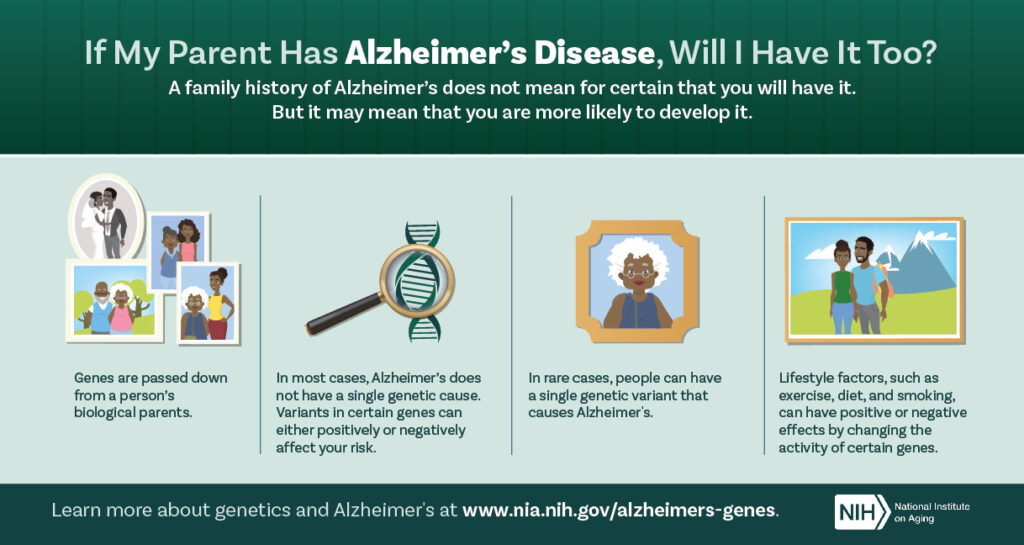
- Family history raises but doesn’t predetermine dementia risk. Having a parent or sibling with Alzheimer’s increases your own risk (about 1.7× in one large study), but genes are only part of the story. Lifestyle and medical factors still matter a great deal.
- Risk varies by dementia type. Late‑onset Alzheimer’s is usually not caused by a single gene, whereas some cases of frontotemporal dementia (FTD) are strongly inherited; Lewy body dementia is rarely hereditary.
- Many risks are modifiable. The 2024 Lancet Commission lists 14 life‑course factors that, when addressed together, could prevent or delay a large proportion of dementias. It’s never too early or too late to start.
- Early evaluation matters. Early diagnosis can mean a slower decline. New disease‑modifying treatments for early Alzheimer’s require confirmation of amyloid pathology and careful risk–benefit discussion with a clinician, but may slow down progression of the disease.
- Caregivers need care, too. Dementia caregiving is linked with poorer mental and physical health; plan support for the care partner from day one.
What your relative’s diagnosis does (and doesn’t) mean for you

Alzheimer’s disease (AD). Most people with Alzheimer’s disease develop symptoms after age 65. In this late‑onset form, risk is shaped by many genes (the best known is APOE ε4) plus medical and environmental factors. Having one first‑degree relative with AD raises your risk compared with people without such a history, but that does not mean Alzheimer’s disease is also your destiny.
When a parent or sibling is diagnosed with early‑onset Alzheimer’s disease, where symptoms develop before age 65, there is a greater risk due to some cases of early-onset Alzheimer’s being autosomal-dominant. If your parent or sibling (also referred to as a first-degree relative) carries a pathogenic variant in APP, PSEN1, or PSEN2, each child and sibling has a 50% chance of inheriting that variant. Inheriting, or carrying the variant, usually means an individual has a very high likelihood of developing Alzheimer’s. That being said, fewer than 10% of all people with Alzheimer’s develop symptoms before age 65, and only about 10-15% of those cases are attributed to one of the single gene variants we have mentioned. Having an early-affected relative does raise your risk but does not mean you too are certain to develop the disease.
Frontotemporal dementia (FTD). Frontotemporal dementia has a higher hereditary component than Alzheimer’s disease. About 20–40% of cases report a family history, and a meaningful subset are due to single‑gene variants (often C9orf72, GRN, or MAPT) that follow an autosomal‑dominant pattern.1 Autosomal dominant means you only need one copy of the changed gene to have a high chance of getting the disease: if a parent has the variant, each of their children has a 50/50 chance of inheriting it. In the 60% of cases that are considered “sporadic,” where there is no genetic connection currently known, genetic testing and meeting with a genetic counselor are still suggested by the Association for Frontotemporal Degeneration.
Lewy body dementia (LBD). Most Lewy body dementia is not inherited; a small percentage of cases are found to involve genes such as GBA or SNCA. In general, family history contributes less to risk for Lewy Body Dementia than Alzheimer’s disease or familial frontotemporal dementia.
Parkinson’s disease dementia(PDD). Parkinson’s disease is only considered hereditary in about 15% of cases. There are genes that have been linked with the risk of developing the disease. There are also genes associated with certain characteristics of the disease if it does develop. Genetics may be able to tell us when PD might develop, how severe it will be, and what the course of the disease could look like for a person.2
Vascular dementia and mixed dementias. These are often linked to cardiovascular risks (blood pressure, diabetes, cholesterol). Rarely, inherited small‑vessel diseases like CADASIL (NOTCH3) cause vascular cognitive impairment.
Should you pursue genetic testing?
Usually not for late‑onset Alzheimer’s. Routine predictive testing isn’t recommended. APOE testing doesn’t definitively predict who will or won’t develop Alzheimer’s disease, and the results of APOE testing can be upsetting and misleading without genetic counseling.
When testing is reasonable: consider requesting a referral to a genetics professional if any of these apply…
- Symptoms or diagnosis of dementia before age 65 in yourself or several relatives.
- Multiple affected relatives across generations with the same dementia.
- A family pattern suggesting Frontotemporal Dementia (especially with motor neuron disease or ALS in the family).
Insurance & privacy note: The federal Genetic Information Nondiscrimination Act (GINA) protects Americans against health‑insurance and employment discrimination based on genetic information, but it does not cover life, disability, or long‑term care insurance; laws vary by state. Consider timing any elective testing with these realities in mind.
How to take action now: A practical, evidence‑based brain‑health plan
A family member’s diagnosis, regardless of its heritability, may be motivating you to make changes to improve and safeguard your physical and cognitive health. Below, you’ll find a list of low‑risk, high‑return steps that you can take right away. These are aligned with the Lancet Commission’s 14 risk factors for dementia3 and other related research. Discuss these changes with your primary care clinician to ensure you can safely implement them or to tailor them according to your current health status.
Hearing: If you (or your loved one) struggle to hear, get a hearing evaluation and use hearing aids if recommended, particularly in later life or if you have other risks. Trials show slower cognitive decline in high‑risk older adults who treated hearing loss.
Blood pressure & lipids: Treat midlife and late‑life hypertension aggressively and manage LDL cholesterol which is now identified as a dementia risk factor.
Vision: Correct cataracts and address untreated vision loss.
Diabetes & weight: Aim for excellent glycemic control and a healthy weight.
Move more: Aim for weekly aerobic and strength activities.4
Don’t smoke; moderate alcohol: Avoid tobacco; keep alcohol use low (heavy use raises dementia risk).
Mood & social connection: Treat depression and engage in regular and meaningful social activities.
Protect your head: Prevent traumatic brain injury. Wear your seatbelt, use a helmet, reduce fall risks and hazards around your home, and take care when playing sports or doing other activities where you risk head injuries.
Air quality: Reduce exposure to poor air quality where feasible. Consider using home air filtration, and try to avoid smoke.
Sleep: Prioritize good sleep habits, and try to schedule wind-down time and set consistent wake and sleep times. If you snore loudly, gasp, or are excessively sleepy, ask about screening for obstructive sleep apnea (OSA); OSA and chronically short sleep are associated with higher dementia risk.
When should you be evaluated?
- If you (or those close to you) notice persistent changes in memory, word-finding, judgment, visuospatial skills (such as getting lost or being unable to find your vehicle in a parking lot), personality, or behavior, you should be evaluated right away.
- Expect a medical work‑up: a thorough history, cognitive testing, labs, and brain imaging may be used to create a well-rounded picture of your cognitive health and contributing factors. In some cases, biomarkers from cerebral spinal fluid, blood assays, or PET scans can be used to clarify diagnosis or verify qualification for certain treatments.
- For people without symptoms, routine screening is probably unnecessary, but it is a good idea to get a baseline assessment of your cognitive function. If symptoms or worries arise later, future evaluation can be compared against earlier or healthy baseline information about you.
- For people without symptoms, routine screening is probably unnecessary, but it is a good idea to get a baseline assessment of your cognitive function. If symptoms or worries arise later, future evaluation can be compared against earlier or healthy baseline information about you.
If you’re also a caregiver: protect your own health
Caregiving is meaningful, invaluable, and stressful. Compared with non‑caregivers, caregivers often report more adverse health indicators, like increased mental health symptoms, poor sleep, and cardiovascular risks. Plan for support now by learning about respite options, joining caregiver support groups and training courses, and letting friends and family know exactly what they can do to help. Prioritize your own medical care and mental health.5
Reliable supports to know:
- Alzheimer’s Association 24/7 Helpline: 800‑272‑3900 The Alzheimer’s Association 24/7 Helpline is a free service offering support for people living with dementia, caregivers, families, and the public. Connect with a live person who can provide information, local resources, crisis assistance, and emotional support.
- Find your Area Agency on Aging to be connected with local resources, events, groups, and more.
- NIA caregiving guides Tips for everyday care, communication, safety, and self-care.
- Legal/financial planning resources: Start planning for future decisions while your loved one can still participate.
Smart steps to take this month
- Map your family & personal risk. Write down which family members had a diagnosis of concern and at what age; create a list of your own vascular risks and hearing/vision issues. Share this with your clinician.
- Book those overdue check‑ups: blood pressure, A1c, lipids, hearing, and vision.
- Schedule yourself: Put 150 minutes a week of moderate physical activity, including two strength sessions, on your calendar. Carve out time for meaningful social connections and cognitively engaging activities you enjoy.
- Get serious about sleep: A good night’s rest is 7 to 9 hours a night for most adults. If you snore and/or deal with daytime sleepiness, ask your primary care provider about Obstructive Sleep Apnea (OSA) screening.
- Start the paperwork: Designate health care and financial decision‑makers in case you are unable to make decisions for yourself at some future time. Complete an advanced directive and let loved ones and health care providers know your wishes.
- Consider research participation (for yourself or your loved one): find studies via Alzheimers.gov Clinical Trials Finder or Alzheimer’s Association TrialMatch.
Frequently Asked Questions
“My parent had Alzheimer’s. Will I definitely get it?”
No. Your risk is higher than average, but many people with a family history never develop dementia, especially those who optimize their cardiovascular health and prioritize vision correction, hearing, and good mental health.
“Should I order a direct-to-consumer gene test?”
Not to predict late‑onset Alzheimer’s disease. APOE testing doesn’t provide a simple yes or no answer and can have emotional and insurance implications. Consider a genetics referral only when there’s an early‑onset disease or a strong, multi‑generational pattern.
“What if my relative’s dementia wasn’t Alzheimer’s?”
If your relative had frontotemporal dementia (FTD), heredity may be stronger. Request a referral for genetic counseling to determine your risk. If your relative had Lewy body dementia (LBD), heredity is uncommon. In Parkinson’s disease dementia, there are genes associated with risk, severity, and disease course, but only 10-15% of Parkinson’s cases are truly considered familial. If a relative has vascular dementia, managing your own cardiovascular and neurovascular risks can help protect your cognitive health.
Bottom Line
A family member’s diagnosis is a cue, not a verdict. Pair a personal risk snapshot with concrete, modifiable steps (hearing care, blood pressure and lipid control, physical activity, mood and sleep treatment, social connection, and safety). Seek early evaluation if concerns arise. Doing these things meaningfully shifts the odds and improves long-term quality of life for you and your family.
This article is informational and not a substitute for personal medical advice. If you have concerns about memory, thinking, behavior, or your own risk, speak with your health care professional.